Texas Energy Code Attic Insulation Requirements Houston Guide
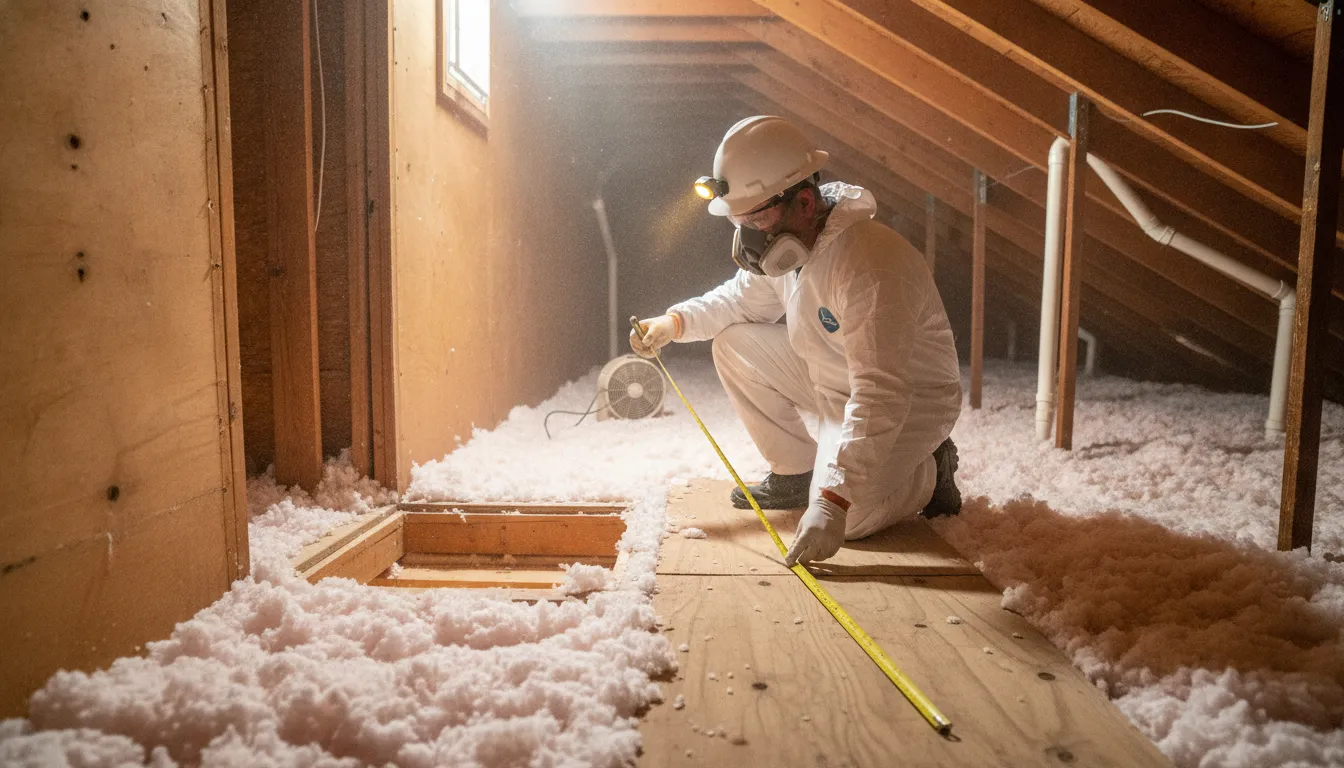
In a Houston summer, an attic that holds heat can make upstairs rooms feel uneven. It can keep the air conditioner running longer and leave you wondering whether the insulation is adequate. The answer is not simply to measure visible depth and compare it with a number.
Texas energy code attic insulation requirements houston depend on the code edition adopted by the applicable authority, any local amendments, and the scope of construction or alteration. Older Texas guidance can provide useful context, but it is not a current compliance guarantee. R-value measures resistance to conductive heat flow, and it also depends on insulation type, thickness, density, age, and moisture, according to the U.S. Department of Energy.
Book Now or Get Quote: (713) 909-0390
That makes the first step a clear distinction between a model energy code, the rules your jurisdiction has adopted, and the conditions inside your attic. Once those roles are clear, you can evaluate what the code discussion does, and does not, tell you about your home.
What Do Texas Energy Codes Actually Govern?
Texas energy codes are not a single attic-insulation number that applies identically to every home. They establish energy-efficiency rules for parts of the building envelope and related systems. The answer for a particular project depends on the code edition, location, and rules adopted by the relevant jurisdiction.
Model code is a starting point, not automatically the local rule
The International Energy Conservation Code, or IECC, is a national model standard for energy-efficient residential construction. The International Code Council develops the model code, and states or local governments adopt an edition through their own processes. A Texas compliance guide based on the 2015 IECC describes itself as an aid using the prescriptive option, not a guarantee that a project complies. Its tables also do not reflect amendments to the IECC. Sources discussing Texas code adoption likewise caution that model-code requirements become mandatory through state and local adoption, not simply because a model edition exists.
That distinction matters when homeowners search for texas energy code attic insulation requirements houston. A table found online may be useful for orientation. But it may not identify the edition or amendments governing a permit in Houston, Tomball, Katy, or another Greater Houston jurisdiction. Texas projects span multiple climate zones and adoption frameworks, and enforcement is not perfectly uniform statewide.
What the rules can cover beyond ceiling insulation
The code discussion can include more than the insulation spread across an attic floor. The cited Texas framework includes an energy chapter for one- and two-family dwellings and addresses additions, alterations, renovations, and repairs. For an alteration, the altered portion may need to meet provisions for new construction. The unchanged portion is not automatically required to be brought up to the same standard. The exact application depends on the project scope and reviewing authority.
Related provisions in the cited 2015 guide address attic access between conditioned and unconditioned spaces, including weatherstripping and insulation equivalent to surrounding surfaces. They also address duct insulation and envelope air leakage. Those examples show why checking only the apparent depth of attic insulation can miss other code-relevant details.
Verify the rule before relying on a number
Before treating an online R-value or checklist as a legal requirement, identify the property's jurisdiction. Check whether the work requires a permit, the adopted code edition, and local amendments. Then confirm the requirements with the responsible building department. An insulation professional can document attic conditions and explain upgrade options, but should not replace the permitting authority or promise compliance without reviewing the governing rules.
Sources: Texas 2015 IECC compliance guide; Texas code research on adoption and amendments; Texas energy-code framework overview.
What Does Houston's Climate Zone Mean for Attic Insulation?
Houston sits in the hot-humid Gulf Coast context commonly associated with Climate Zone 2A. In practical terms, summer cooling demand is a major enclosure concern. Heat moves from the hot attic toward the cooler rooms below, while air leaks through gaps and penetrations can carry heat and moisture into the home. That is why an attic discussion should cover more than insulation depth. Continuity, air sealing, moisture control, and the condition of the existing assembly all matter.
R-value is a plain-language measure of how strongly insulation resists conductive heat flow. A higher R-value generally means greater resistance, but the number is not a complete description of an attic's performance. The result also depends on insulation type, thickness, density, temperature, age, and moisture. Loose-fill insulation can settle and compress, so its R-value does not always increase in direct proportion to added depth. The U.S. Department of Energy's insulation guide explains these heat-flow and R-value principles in more detail. You can also review this site's guide to understanding attic R-values in Houston, while keeping the present article's focus on code verification.
Historical Texas guidance based on the 2015 IECC prescriptive tables is useful for understanding why homeowners may hear different numbers. It lists R-38 for ceiling insulation in Climate Zones 2 and 3, while Zone 4 is listed at R-49. Those figures are educational context from that cited guide, not a current legal guarantee for every Houston property. The code edition adopted by the applicable authority, along with local amendments and the scope of the project, controls any current requirement.
| Topic | What the cited guide says | Homeowner takeaway |
|---|---|---|
| Houston climate context | Climate Zone 2A represents hot-humid Gulf Coast conditions where cooling demand is a central enclosure concern. | Look at heat flow, air leakage, moisture, and insulation continuity, not just the label on a product. |
| R-value meaning | R-value measures resistance to conductive heat flow, and higher values indicate greater insulating effectiveness. | Use R-value as one comparison point, then account for material, installation quality, settling, and moisture. |
| Historical Zone 2 and 3 reference | The cited 2015 Texas guide lists R-38 for ceiling insulation in Zones 2 and 3. | Treat this as historical educational context. Confirm the currently adopted edition and local requirements before calling an attic compliant. |
For a Houston homeowner, the useful question is not simply. "Do I have R-38?" It is whether the attic's installed assembly is appropriate for the home's climate. Project scope, and governing requirements. A qualified review can document what is present before any upgrade decision is made.
How Can You Check Texas Energy Code Attic Insulation Requirements in Houston?
Start with the address, not a generic attic chart. Texas energy code attic insulation requirements in Houston can depend on the authority having jurisdiction, the work being performed, the adopted code edition, and local amendments. A table from an older guide can help you understand the terminology, but it should not be treated as a current approval or a universal requirement. The cited research specifically warns that project minimums depend on the code edition and local amendments enforced at permitting: see the code-edition and permitting caveat.
Use this verification path before planning an insulation project:
- Identify the local jurisdiction. Confirm whether the home is inside the City of Houston or in a nearby municipality or unincorporated area such as Tomball, Sugar Land, Katy, or The Woodlands. The relevant building department may differ by location, and Texas enforcement is not perfectly uniform statewide. Ask which office reviews residential energy-code questions for the property.
- Describe the work accurately. Tell the authority whether you are adding insulation to an existing attic, removing and replacing insulation, altering the ceiling assembly, replacing ductwork, or completing a broader renovation. The cited Texas framework says its residential energy chapter applies to additions, alterations, renovations, and repairs. It also describes an important distinction: the altered portion generally must meet new-construction provisions, while unaltered portions are not automatically required to comply.
- Ask which code edition and amendments apply. Request the current adopted residential energy-code edition, the applicable local amendments, and the compliance path for your project. Do not assume that a 2015 Texas guide, a 2021 reference, or an online contractor article reflects the edition currently enforced at your address. Prescriptive R-values are minimum acceptable levels within a cited code framework, not a promise that one number applies to every project.
- Check more than the ceiling insulation. Ask specifically about the ceiling or attic plane, the attic access hatch, air sealing, and ducts located in an unconditioned attic. The cited guide addresses access doors between conditioned and unconditioned spaces, requiring weatherstripping and insulation equivalent to surrounding surfaces. It also gives duct insulation provisions and envelope air-leakage requirements that vary by climate zone. These items can matter even when the attic floor appears to have adequate insulation.
- Get confirmation in writing. Save the department's webpage, permit guidance, email response, or plan-review notes with the project records. If the authority requests a permit, inspection, documentation, or a specific compliance method, follow that process. An insulation professional can document existing conditions and discuss practical options, but only the local authority can clarify what it will accept for the permitted work.
This process keeps a useful distinction in view: an insulation upgrade may improve comfort and reduce heat flow. While code compliance is determined by the adopted rules and the project's scope. When those details are uncertain, verify them before materials are ordered or work begins.
How to Inspect an Existing Houston Attic Before Upgrading
- Start with insulation depth and evenness. From the attic access, look across the ceiling plane without stepping between joists. Note whether the insulation forms a reasonably consistent layer or has thin spots, bare areas, compressed sections, or gaps around framing. Do not convert inches directly into an R-value. R-value depends on the insulation type, thickness, density, temperature, age, and moisture accumulation. Loose-fill insulation also does not gain R-value in a perfectly proportional way as depth increases because its density can change under compression. Photographing several areas can help a professional compare conditions later.
- Look for damage, moisture, or contamination. Check for darkened or damp-looking insulation, water staining on roof framing, compressed material, mold-like growth, pest evidence, and debris. Do not disturb suspicious material or assume that adding insulation will solve a roof leak, plumbing leak, or ventilation problem. Moisture can affect insulation performance, so the cause should be identified before an upgrade. If you see active dripping, extensive staining, damaged wiring, or unsafe flooring, stop the inspection and arrange qualified help.
- Find air leaks and penetrations. Inspect around light fixtures, plumbing vents, electrical penetrations, duct openings, top plates, chimneys, and other points where the ceiling plane is interrupted. Air movement through gaps and penetrations can carry heat and moisture, which is why insulation continuity and air sealing matter together. Do not seal around heat-producing equipment or electrical components unless the appropriate professional confirms the safe method.
- Check the attic access panel. A pull-down stair, hatch, or door can be a major weak point between conditioned and unconditioned space. The cited Texas guide says access doors should be weatherstripped and insulated to a level equivalent to the surrounding insulation. Confirm that the panel closes tightly, has visible insulation, and does not leave an obvious perimeter gap. This is an observation, not a substitute for verifying the code edition that applies to your project.
- Observe ducts and ventilation without moving them. Look for torn or disconnected duct insulation, crushed flexible duct, disconnected joints, blocked soffit openings, and signs that vents are obstructed. The historical Texas guide includes duct-insulation provisions, but current requirements depend on the adopted code and local authority. Never crawl across unsupported drywall or move ductwork to inspect a hidden area.
- Connect attic conditions to comfort symptoms. Record rooms that stay hot, uneven temperatures, high summer cooling demand, or areas that never feel comfortable. Insulation resists heat flow and can improve comfort, but these symptoms may also involve air leakage, ducts, ventilation, windows, or HVAC performance. A written list helps keep the upgrade focused on the actual problem.
- Know when to stop and request an assessment. Leave the attic if heat, limited flooring, steep roof geometry, poor lighting, pests, suspected asbestos, exposed wiring, or moisture makes the inspection unsafe. A professional evaluation should consider depth and evenness, damage or contamination, air leakage, ventilation, and comfort symptoms. Homeowners with older properties can also review upgrading insulation in an older Houston-area home before deciding what to do next.
An inspection can show where questions begin, but it cannot by itself certify code compliance. Keep photos and notes, then confirm the applicable requirements with the relevant Houston-area building authority before treating an upgrade as a code solution.
Is R-38 Enough for a Houston Attic?
Sometimes, but R-38 is not a universal legal answer for every Houston attic. A commonly cited 2015 Texas prescriptive guide lists R-38 for ceilings in Climate Zones 2 and 3, the zones often discussed for Houston and nearby areas. That guide is an educational aid based on a specific code edition, and its table does not account for every later amendment or local requirement. Project-specific requirements depend on the code edition and local provisions being enforced when the work is permitted.
That distinction matters when researching texas energy code attic insulation requirements houston. A historic table can help explain why R-38 appears in older documents, but it should not be treated as a current compliance certificate. If you are remodeling, adding insulation, or opening an attic for other work. Confirm the applicable requirements with the authority having jurisdiction or a qualified professional who can review the project scope.
R-value measures resistance, not the condition of the installation
R-value describes an insulation material's resistance to conductive heat flow. The U.S. Department of Energy notes that the stated value depends on the insulation type, thickness, density, temperature, aging, and moisture accumulation. In other words, the number printed on a product or listed in a table does not describe every detail of an existing attic. See our guide to understanding attic R-values in Houston for additional background, but keep this article's code-focused question separate from a general product comparison.
Installed condition can change the practical result. Loose-fill insulation may settle or become compressed, and its R-value does not increase in a simple one-to-one relationship with depth. Batt insulation can have gaps, voids, or compression. Any material can perform poorly where moisture, damage, or uneven coverage interrupts continuity. Air movement through penetrations can also carry heat and moisture around the insulation, so simply measuring one spot may not tell the full story.
Why a professional evaluation may be worthwhile
A useful attic review checks more than whether the insulation appears to reach a particular mark. It considers the material, depth across the attic, evenness, compression, moisture signs, air leakage, and areas around penetrations and the access hatch. It also considers comfort symptoms, such as rooms that remain unusually hot or uneven during Houston's cooling season. The result is a more defensible recommendation: retain, redistribute, repair, or add insulation after the attic's actual condition and the applicable project requirements are understood.
Which Insulation Approach Fits the Attic's Condition?
Texas energy code can set a performance or insulation target, but it does not automatically select one universal material for every Houston attic. The right approach depends on what is already in place, how evenly it covers the ceiling. Whether moisture or contamination is present, and how easily the crew can reach the work area. A code discussion is about requirements; an attic assessment is about matching those requirements to the home's actual condition.
Blown-in fiberglass can be useful when an existing attic needs more continuous coverage around irregular areas. EZ Attic Insulation describes it as adaptable to attics, walls, and crawl spaces, with the potential to help cover gaps and cracks when professionally installed. Its final performance still depends on proper distribution, settled depth, and the condition of the surfaces below it. Loose-fill R-value does not necessarily rise in direct proportion to thickness because compression can change its density. So simply adding material without checking coverage can give a misleading picture.
Batt fiberglass may fit an attic with accessible, regularly spaced areas where pieces can be installed and kept in contact with the intended surface. It is not automatically the best answer for every retrofit. Gaps, compression, obstructions, and penetrations can leave weak spots, especially when the existing layout is irregular. The assessment should look at continuity rather than judging the material name alone.
Spray foam is another option in the company's service mix. Its suitability depends on the assembly, access, moisture conditions, and the scope of the work. It should not be selected merely because it sounds more advanced. The same condition-first principle applies to a radiant barrier. Most insulation slows conductive and convective heat flow, while radiant barriers work by reducing radiant heat gain, so they address a different part of attic heat transfer. The U.S. Department of Energy explains this distinction in its insulation guidance.
For a concise overview of the options without treating one material as a universal answer, see attic insulation types for Houston homes. In practice, a professional review should document depth and evenness, visible damage or contamination, air leakage, ventilation, and comfort symptoms before recommending an upgrade. That evidence is more useful than choosing a material from a code table alone.
When Should a Houston Homeowner Schedule an Attic Assessment?
An attic assessment makes sense when insulation is uneven, visibly damaged, contaminated, compressed, or too thin to address the home's comfort problems. It is also a practical next step when some rooms stay hot, cooling costs feel difficult to control, or the home struggles during Houston's long summer season. Insulation resists heat flow, but its real performance depends on the installed material, coverage, moisture exposure, air leakage, and the condition of the surrounding attic.
An assessment is especially useful before adding new insulation over an existing layer. A professional can look for conditions that should be addressed first, such as damaged insulation. Gaps around penetrations, concerns near the attic access, ventilation issues, or ductwork that needs attention. This is an evaluation of the attic and a basis for recommendations, not a substitute for a formal code review or a promise of legal compliance.
What happens during the EZ Attic process?
EZ Attic Insulation begins with an inspection and estimate based on the attic's condition and the homeowner's goals. The review considers insulation depth and evenness, visible damage or contamination, air leakage, ventilation, and comfort symptoms. If removal is appropriate, the work plan can include taking out outdated or damaged insulation before installing fresh material.
Before installation, the crew prepares the work area to help protect the home and keep the project organized. The installation approach is selected for the attic's condition rather than assumed from a single code number or material preference. Afterward, the team checks distribution so coverage is not left thin in obvious areas, then cleans the work area. That sequence gives homeowners a clearer view of what was found, what was done, and what still deserves attention.
EZ Attic Insulation is locally and family-owned in Tomball and serves homeowners across Greater Houston. The company is 100% certified and insured, with a BBB A+ accreditation. Homeowners ready to discuss uneven or insufficient attic insulation can review the professional attic insulation service in Houston and decide whether an assessment fits their situation.
Book Now or Get Quote: (713) 909-0390
Frequently Asked Questions
What are the Texas energy code attic insulation requirements for Houston homes?
The answer depends on the code edition and local requirements governing your project. A commonly cited 2015 Texas guide lists R-38 for ceiling insulation in Climate Zone 2, which includes Houston in the guide's example. But that document is an educational compliance aid and does not account for later adoption or local amendments. Confirm the applicable requirements with the authority having jurisdiction before treating any value as a legal minimum. Source
Does Houston's climate zone change the attic insulation requirement?
Yes, climate zone is one factor used in energy-code tables, so Houston should not automatically be evaluated using a requirement from another part of Texas. Climate zone alone does not settle the question, however. The adopted code edition, local amendments, project type, and whether you are building, remodeling, or repairing can also affect what applies.
Is R-38 enough for a Houston attic?
R-38 may match the ceiling value listed in the cited 2015 guide for Climate Zone 2, but it is not a universal answer for every Houston home. R-value depends on insulation type, thickness, density, aging, and moisture. Loose-fill insulation also does not gain R-value in direct proportion to depth because compression changes its density. Inspect the installation and verify the current code path before deciding whether an upgrade is needed. Source
How many inches of insulation should be in my attic?
There is no reliable inch count without knowing the insulation material and its installed condition. Different products achieve different R-values per inch, and settled or compressed loose-fill can perform differently from a simple depth estimate. Check for consistent coverage, moisture, gaps, and compressed areas, then use the product information or a qualified assessment to interpret the measurement.
Ready to Check Your Houston Attic?
A practical attic assessment can help you understand your insulation's condition and identify questions to verify with your local authority before planning an upgrade. EZ Attic Insulation can help Houston-area homeowners review the next step without promising a universal code outcome.
Book Now or Get Quote: (713) 909-0390
Hablamos Espanol!